The tightening of U.S. immigration policy in 2025 has pushed thousands of migrants to stay in Mexico, where they have begun to settle and build their lives in cities such as the country's capital, having put aside their plans to head north, at least for this year.
Among them is Eduardo, 41, who left his native Venezuela six years ago and has been living in Mexico City for two years, where he now envisions his future, at least for 2026. For now, he tells EFE, he is not concerned about crossing into the United States, because although he knows he can find employment, he would have to "hide from ICE," like many migrants living in the U.S.
More than 58,800 foreigners have sought asylum in Mexico between January and September 2025, according to a report from the United Nations High Commissioner for Refugees (UNHCR) with data from COMAR. Nearly 30% of the applications in 2025 were filed in Mexico City, with around 17,600 registrations. In all of 2024, of the nearly 78,800 petitions in Mexico, about 14,300 were in the capital, which is 18%, according to the report.
Staying as a destination
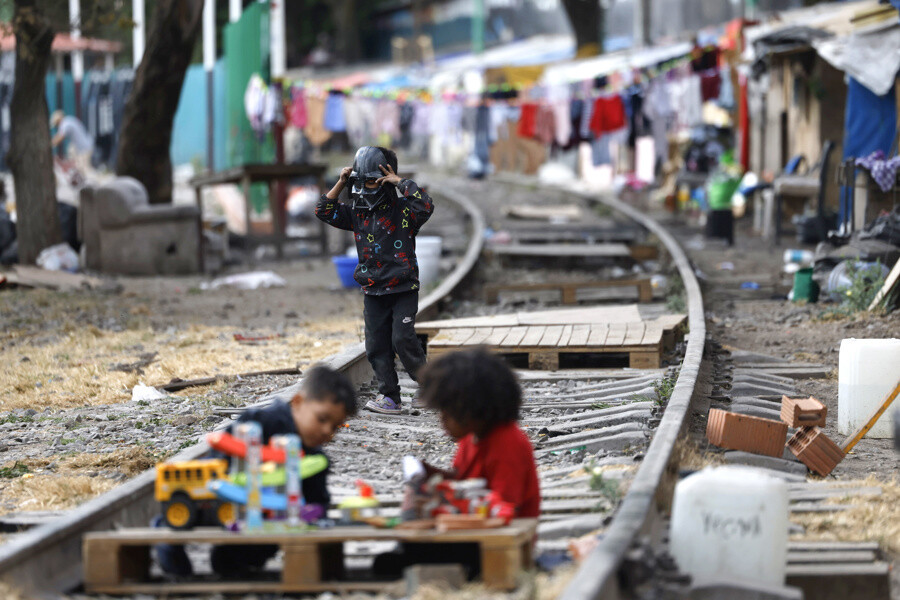
For the past two months, Eduardo has been living in the Vallejo camp, a settlement of migrants living between wooden walls, tarps, and other recycled materials on some abandoned railroad tracks north of the capital. He arrived there after he could no longer afford to pay rent, but he hopes to recover quickly from an injury to return to his usual job, unloading containers at Chinese warehouses, where he can earn up to 800 pesos (about $45) a day.
His home is in a corner of the camp next to several neighbors' motorcycles that work as delivery drivers, he explains, a job with great risks, such as accidents and constant exposure due to lack of documents. The lack of papers also pushes them to accept lower wages than locals, relates Viviana, a 37-year-old Venezuelan whose husband works in construction. "Sometimes, because we are immigrants, they want to pay you less, they want to use you (...) you ask a Mexican how much he earns and he does the same as you and earns more and they are working in the same place (...) the employer tends to exploit the immigrant a lot," Viviana states.
Venezuelan migrant Eduardo poses during an interview with EFE this Friday in Mexico City (Mexico). He first arrived in Tapachula (Chiapas, south) with his young daughter and husband, and four months ago they managed to reach Mexico City (center), he recalls, amid an increase in operations that "returned" migrants to the southern border. Although his initial plan was Canada, today he acknowledges that the lack of documents makes it unviable and affirms that "the United States is no longer an option." "(We want) to stabilize here in Mexico (...) my plan was not Mexico, it was Canada, but there is no other choice, we have to keep fighting," he affirms.
46% of migrants surveyed in 2025 considered Mexico their destination, compared to 24% in 2024, according to data from the International Organization for Migration (IOM) of the United Nations. Half are from Venezuela, with 50%, followed by Honduras (12%); Guatemala (10%), and Colombia and Ecuador (7% each), according to the IOM.
Photo EFE
From transit to destination: staying in Mexico marks the 2026 migration trend
"Life is better here," says Eduardo, whose life project collapsed a year ago with the cancellation of the CBP One appointment program, after Donald Trump's return to the White House in January 2025. In Mexico City, Eduardo has found temporary work and recently began the process to apply for asylum with the Mexican Commission for Refugee Assistance (COMAR), one of his "new plans" for this 2026. Venezuelan migrant Viviana poses during an interview with EFE this Friday in Mexico City (Mexico). with fear of operations by U.S. Immigration and Customs Enforcement (ICE). "Here you don't have that unease of going out and they are going to deport you or anything (...) To live for 3 more dollars and in constant anxiety, no, I prefer to stay here then."